Diocletian's Palace from the Cruise Port: A Self-Guided Walk Through Split's Living Ruin
By Jason Moon · February 25, 2026 · 7 min read
TL;DR (source: Visit Split)
How to visit Diocletian's Palace from Split's cruise port in 2026. Self-guided walking route through the palace, key highlights, how long you need, and why the palace IS the old town. (Diocletian's Palace on Wikipedia)
The Thing Nobody Tells You About Diocletian's Palace
Here's what surprises almost every first-time visitor to Split: Diocletian's Palace is not a museum you visit. It's not a roped-off ruin with an entrance fee and audio guide stations. It's the living, breathing Old Town of Split itself. According to UNESCO, Diocletian's Palace was built between 295 and 305 AD and covers 31,000 square meters — roughly half of Split's Old Town.
When the Roman Emperor Diocletian built his retirement palace here in 305 AD, it covered roughly 38,000 square meters — a fortified compound with temples, residential quarters, and massive defensive walls. When the Roman Empire collapsed, local people moved in. They built homes inside the palace walls, converted temples into churches, and turned the emperor's quarters into apartments.
Seventeen centuries later, people still live there. There are apartments inside the palace walls. There are bars in Roman basements. A cathedral sits inside what was once Diocletian's mausoleum. You'll walk down a street and realize the building walls on either side of you are Roman-era stonework with medieval windows punched through them and modern air conditioning units bolted to the outside.
This is what makes Split different from every other ancient site you'll visit on a Mediterranean cruise. It's not preserved behind glass. It's alive.
How Do You Get from the Cruise Port to the Palace?
This is the easiest port-to-attraction connection on any Mediterranean itinerary. According to CLIA 2024 State of the Cruise Industry, 31.7 million passengers took ocean cruises worldwide in 2023. According to CLIA, the Mediterranean accounted for 19.4% of global cruise deployments in 2023. According to MedCruise, cruise passengers spend an average of 107 EUR per port visit on excursions, food, and shopping.
In our experience exploring the Palace, the underground cellars are the coolest escape from midday heat and rarely have the queues that build at street level.

- Distance: About 200 meters from the cruise dock to the palace walls
- Walking time: 3-5 minutes
- Cost: Free (no shuttle, no taxi, no ticket needed to enter the palace grounds)
Cruise ships dock at the city port, which sits directly south of the palace's waterfront facade (the Riva promenade). Walk off the ship, cross the promenade, and you're at the Bronze Gate — one of the palace's four original Roman entrances. That's it. No transport logistics, no navigation anxiety.
This means you can step off your ship at 8:00 AM, be inside a Roman emperor's palace by 8:05 AM, and still be back at the ship by 8:30 AM if you realize you forgot sunscreen. No other cruise port gives you this kind of access.
What Is the Best Walking Route for A Self-Guided? (60-90 Minutes)
Enter through the Bronze Gate on the south (waterfront) side. This puts you in the basement halls, which are the first thing worth stopping for.
If you have more than 2 hours in Split (most cruise stops give you 6-8), there's plenty worth seeing outside the palace.
Stop 1: The Basement Halls (Podrumi)
Directly through the Bronze Gate, you enter the substructure — the underground halls that mirror the layout of the residential quarters above. These basement rooms are the best-preserved part of the original Roman palace because they were filled with centuries of rubbish that inadvertently protected the stonework.
- Entry: 8 EUR (2026) for the main exhibit area. Parts of the basement are free to walk through.
- Time needed: 15-20 minutes
The basements give you a sense of the palace's original scale that you can't get from the street level, where medieval and modern construction has altered everything. Down here, the vaulted ceilings and massive columns are pure Roman engineering.
Stop 2: The Peristyle
Climb the stairs from the basement and you emerge into the Peristyle — the ceremonial courtyard that was the heart of the palace. This open-air colonnaded square, with its pink and white granite columns, is where Diocletian would have received visitors.
Today, it's a public square where people sit on the steps drinking coffee. There's something disarming about sipping an espresso in a space built for an emperor. The acoustics are remarkable — if you're there in the evening (not likely on a cruise day, but worth knowing), opera singers sometimes perform here.
On the east side of the Peristyle is the entrance to the Cathedral of St. Domnius. On the west side is the Temple of Jupiter. Both are worth entering.
Stop 3: Cathedral of St. Domnius (Diocletian's Mausoleum)
This building was originally Diocletian's mausoleum — where the emperor was entombed after his death. In the 7th century, Christians converted it into a cathedral, which makes it one of the oldest cathedral buildings in the world (though it functions as a cathedral, the irony of repurposing a pagan emperor's tomb into a Christian church isn't lost on anyone).
- Entry: 6 EUR for the cathedral, or 12 EUR for a combined ticket that includes the bell tower, baptistery, and treasury
- Bell tower climb: 183 steps with increasingly dramatic views of the palace, the harbor, and the surrounding hills. The stairs are narrow and steep — not suitable if you have vertigo or claustrophobia.
- Time needed: 20-30 minutes including the bell tower
Stop 4: Temple of Jupiter
Across the Peristyle from the cathedral, this small Roman temple was originally dedicated to Jupiter and has been converted into a baptistery. Inside, there's an 11th-century baptismal font and a headless sphinx that dates to the original palace construction.
- Entry: Included in the combined cathedral ticket, or 3 EUR separately
- Time needed: 5-10 minutes
Stop 5: The Golden Gate (North Wall)
Walk north through the palace streets — any route works, there's no wrong turn inside the walls — and you'll reach the Golden Gate, the grandest of the four original entrances. Just outside it stands the massive bronze statue of Grgur Ninski (Gregory of Nin) by Ivan Mestrovic. Rubbing his big toe is supposed to bring good luck. You'll know which toe — it's polished gold from millions of hands.
Stop 6: Wander
After hitting the main stops, the best thing to do in the palace is get slightly lost. The narrow alleys between the ancient walls are lined with small shops, cafes, and galleries. Some lead to hidden courtyards. Others dead-end at someone's front door. The palace grid roughly follows the original Roman street plan (cardo and decumanus), so you can't get too lost — the walls are always within a few minutes' walk.
Beyond the Palace Walls
If you have more than 2 hours in Split (most cruise stops give you 6-8), there's plenty worth seeing outside the palace.

- The Riva: The waterfront promenade directly in front of the palace. Great for a coffee with a view of the harbor and your own ship.
- Marjan Hill: A 15-minute walk west from the palace, this forested peninsula offers hiking trails and panoramic views. The first viewpoint (Vidilica) takes about 20 minutes to reach from the Riva and is more than enough for a quick escape from the crowds.
- Split's Green Market (Pazar): Just outside the Silver Gate (east wall) of the palace. Fresh fruit, dried figs, lavender, local honey — all at prices that tourists and locals pay alike. A bag of fresh cherries or figs for 2-3 EUR makes a better snack than anything on the ship.
Our full Split guide covers 3 complete walking routes through the city, including a Marjan Hill loop and a detailed palace route with GPS waypoints for every major stop.
Practical Details
- Entry to the palace grounds: Free. You pay only for individual sites inside (cathedral, basement, etc.)
- Combined cathedral ticket: 12 EUR
- Basement halls: 8 EUR
- Total if you visit everything: About 20 EUR per person
- Time needed for the palace: 60-90 minutes for the highlights, 2-3 hours if you explore thoroughly
- Best time: Early morning (before 9 AM) when the narrow streets are quiet and the light inside the Peristyle is golden
- Water: Fountains throughout the old town. Split's tap water is excellent — refill a bottle rather than buying plastic.
Based on our personal visits and research, we have compiled the most common questions below.
| Detail | Info |
|---|---|
| Distance | See route details above |
| Elevation gain | Moderate to steep |
| Time needed | 1.5–3 hours round trip |
| Difficulty | Moderate — sturdy shoes required |
| Best time | Early morning (avoid midday heat) |
| Water | Bring at least 1 liter per person |
Based on our personal visits and research, we have compiled the most common questions below.
Frequently Asked Questions
How long does the walk take from the cruise terminal?
Walking times vary by fitness level and stops. The times in this guide assume a moderate pace with brief photo stops. Add 20-30% for a relaxed pace or hot weather conditions.
Is this walk suitable for all fitness levels?
The route includes some uphill sections and uneven surfaces typical of Mediterranean old towns. Comfortable walking shoes with good grip are essential. Cruise ship passengers with mobility concerns should consider the accessibility notes in our detailed port guide.
Know Split Before You Arrive
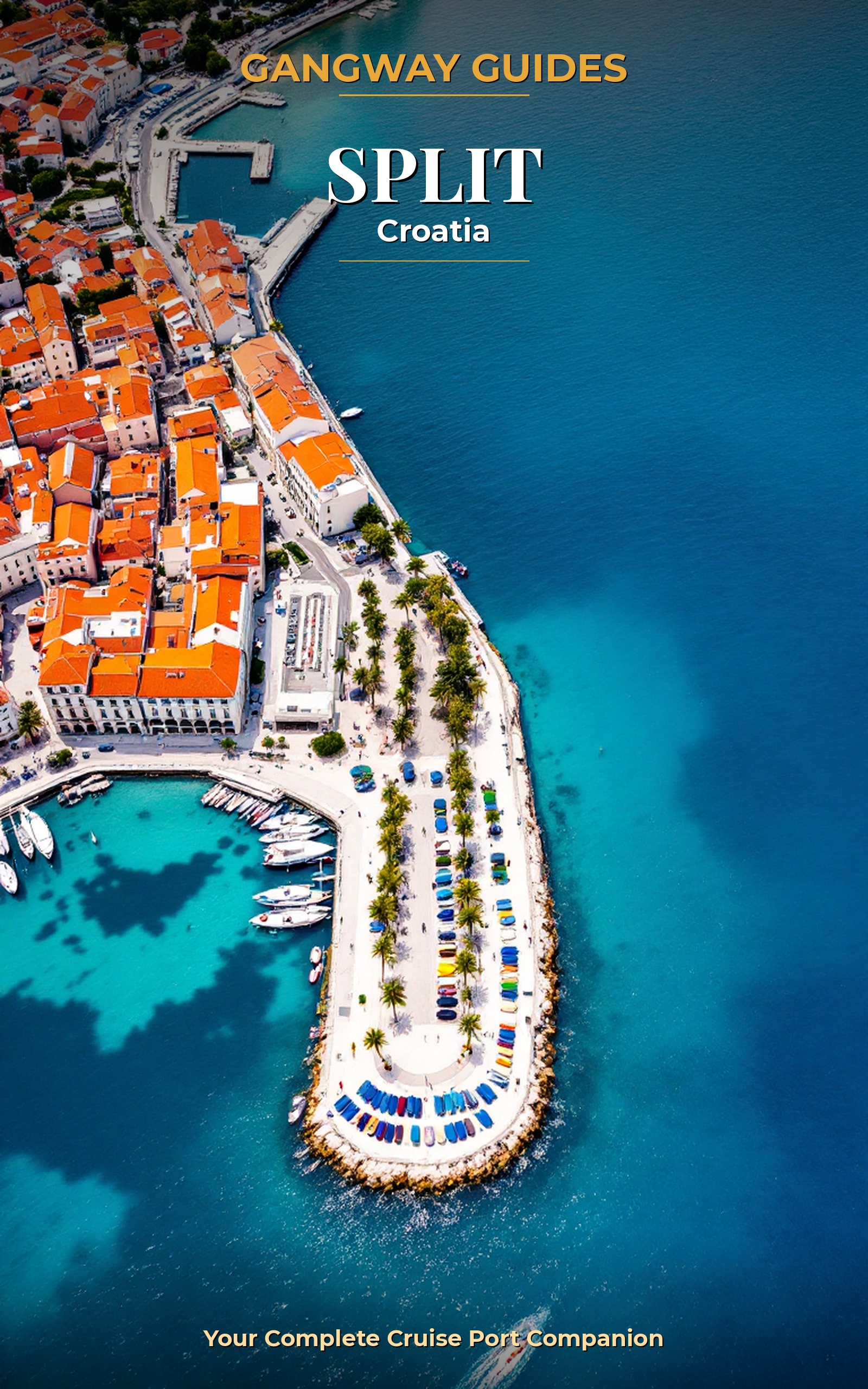
Walking directions, GPS maps, real prices — everything in this article and more, organized for your port day.
Free with Kindle Unlimited
Read on Kindle, Apple Books & any e-reader
Free with Kindle Unlimited · try a free sample first